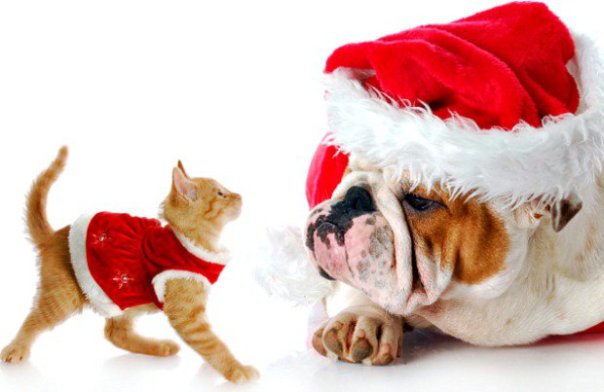
Don’t be blue about leaving your loved ones at home.

cat dog in holiday hats 2015
Bring your pet with your when you travel for the holidays

Just because you’re traveling for the holidays doesn’t mean you have to leave your pooch at home! A great way to include your beloved pet in your holiday traditions this year is to bring them with you, no matter where you travel to over the holidays. Most hotels, even the highest-end hotels, are pet-friendly now, and if you’re staying with family, it’s even less of a concern. By bringing your pet with you to your holiday travel destination, they’ll be part of the holiday action, just like they would be in your own home.

Of course they should be use to traveling.  Our doggies particularly like Motel 6 because they are all laid out the same.  I have seen fellow pet lovers with their cats, guinea pigs, and other small animals at Motel 6 as well.

Safe travels and enjoy the holiday season.


Deer, Dog Find Friendship at German Christmas Tree Farm

DURBACH, Germany — Deer and dogs are not natural companions, but nobody seems to have told Carla the Labrador.

A year-and-a-half ago the canine was out walking in Germany’s Black Forest when they came upon a solitary fawn. Carla licked the little deer, and shoved it gently with her nose, owner Helga Kuderer told NBC News.

Watch Carla the Labrador and Peterle the Stag Playing0:57

“Carla immediately took up a mother role, when she found the abandoned baby stag during a hike through the forest,” the 52-year-old recalled.

The two have become the best of friends.

Kuderer, who owns a 200-year-old Christmas tree farm with her husband Andreas, adopted the orphaned deer and named it Peterle. The family raised the young stag, feeding it bottles of goat milk for nearly six months before it returned to the woods on its own.

But that didn’t end the odd relationship.

“Every day, Peterle visits Carla, they play around, cuddle and then eat some oatmeal and dog cookies together,” Helga Kuderer said.

Image: Peterle and Carla
Peterle and Carla meet over lunch this week. Andy Eckardt / NBC News

At this time of year, customers and visitors to the farm often witness the gentle exchanges between the two buddies or watch a wild playful chases through the rows of lined-up Christmas trees.

Peterle has been spotted with other deer at times, but can be easily identified by his bright orange collar.

“The stag wears the signal colors, so that hunters in the region do not go after him,” Kuderer said.

Other animals on the farm — chicken, rabbits and a goat — have also accepted the presence of the wild neighbor.

“Only the goat needs to be kept locked inside at the moment because it likes to eat our Christmas trees,” Kuderer said.

How to adopt a dog through breed-specific rescue groups

five purebred dogs

Photo: cynoclub/Shutterstock

It may come as a surprise, but you don’t have to go through a breeder to find the perfect purebred dog. If you have your heart set on a specific breed, there are dog rescues waiting to match you with your ideal companion. You can help a rescued dog find a forever home and get the dog you’ve been dreaming about.

Why dogs end up in breed-specific rescues:

There is a misconception that getting a dog from a breed-specific rescue is less desirable than getting one from a breeder. Dogs who end up in rescues aren’t there because they’re rejects from breeders, or substandard in any way. Often, the dogs who end up in these rescues are given up by owners who underestimated the effort it takes to raise a dog, or they figured out that the breed they chose isn’t the right match for their personality or lifestyle. And many times they are well-loved dogs whose owners had to give them up because of life changes, like moving, divorce, a new job or leaving the country.

Dogs also end up in breed-specific rescues when puppy mills are shut down. Additionally, when shelters receive pure-bred dogs, usually about 20-30 percent of the dogs they receive, they often turn them over to breed-specific rescues so that the shelter has more room for mixed-breed dogs in need of homes.

Whatever the reason, dogs that end up in breed-specific rescues are every bit as good as any other dog. So if you’re convinced you want a purebred dog, be assured that rescues are a great way to find the perfect companion for you.

What to expect when adopting from a breed-specific dog rescue:

Breed-specific rescues, like other rescue groups, put a great deal of energy, expense, and care into the dogs they re-home. The rescues are an effort of love, and the diligence they put into finding the perfect match between a dog and a forever home shows it. The rescue is there for the dogs’ best interests, not the desires of potential owners, so expect to do a little hoop-jumping when adopting. This will benefit you in the long run by making sure you bring home the perfect dog for you.

Breed-specific rescues will first make sure that you’re the right kind of person for the breed you’re seeking to adopt. What kind of home you have, how active you are, how much time you want to invest in grooming, if you’re aware of health issues for the breed, if you have kids or other pets, and so on. All these factors determine if your home is right for the breed, and if it is, if there is a dog in the rescue whose personality matches up with you and your home.

Expect to fill out an application, be interviewed, and have an in-person home check. It may feel like a hassle but there is a reason for the red tape. There are too many instances of people who adopt dogs only to neglect or abuse them, to turn them back in to the rescue when things don’t work out, to immediately sell them to make money, or use them as bait dogs in fighting rings. Any rescue worth its salt will do extra work to avoid these outcomes.

What is also great about breed-specific rescues is you can get a dog that is the breed you want and also has personality characteristics you know you want. You can find dogs of all ages, and all temperaments; you can look for an adolescent dog with a boisterous personality, or an adult dog that has mellowed out. The rescue will be able to tell you everything you need to know about each dog’s personality and quirks so you can minimize the surprises when you bring your new pet home.

Figure out what breeds are best suited to your personality and lifestyle.
You may love the look of a certain breed, but it could end up being the last companion you want to live with. For example, when the movie ‘101 Dalmatians’ came out, people rushed out to get the cute spotted pups. But what many didn’t realize is that dalmatians are high energy dogs who need a lot of activity, can be protective and stubborn, and can have serious health issues. English bulldogs are another favorite for their frumpy faces and stumpy bodies; however, they require daily grooming of all those folds of skin to avoid infections. They also like to lay around and snooze, so they aren’t ideal for a person or family with an active lifestyle, no matter how cute they look.

Another perfect example is the border collie. Border collies are so smart, so they’d be so easy to train and live with, right? Nope! That high energy level means they need several hours of running every day and a lot of mental stimulation like agility training or learning tricks. If you can not provide that, you might find yourself with a dog literally going crazy, compulsively running in circles or chewing walls. Many people don’t realize this until the damage is done.

In other words, if a breed-specific rescue is trying to talk you out of adopting their breed, you may want to listen to them. Here’s an excellent quiz that will help you determine which dog breeds are best suited for your personality and home life.

Finally, don’t rule out mixed-breed dogs. Often, they have fewer genetic health problems, live longer, and are less expensive to own since they (usually) require fewer trips to the vet and groomer.

Find a breed-specific dog rescue:

So you are absolutely sure you want a purebred dog, and you have narrowed down the breeds that are right for you. The next step is looking up breed specific rescues. Luckily, there is a rescue (or many!) for pretty much every breed of dog imaginable. You can find updated listings of rescues at:
Adopt-a-Pet
American Kennel Club
Petfinder, where you can search by breed, age, sex, size and location

All Dogs Welcome

Also, calling your local shelters and asking for information for nearby breed-specific rescues is always a good place to start.

The Neighborhood Cats Winter Shelter

Cats winter

The Neighborhood Cats Winter Shelter

by http://www.neighborhoodcats.org

We suggest these safe havens even for our own cats that go out with us in the morning as we leave for work.  If you can’t get home or the weather turns ugly they can always have refuge from the harsh elements. ~Melissa

For detailed instructions on how to build, click here
To view photos of how to assemble, click here. Picture trail courtesy of Arjun Ray.

Originally designed by Karin Hancock of Port Washington, NY, our favorite feral cat winter shelter has many advantages. The two-inch thick hard Styrofoam is excellent insulation and traps the cat’s body heat, effectively turning the feline into a radiator.  Air space is purposely limited, so there is less volume to be heated. Typically, 3 to 4 cats can fit comfortably inside, although more might curl up on a severely cold night.

The shelter is lightweight and should be weighed down.  Best is to place two shelters about a foot apart with the doors facing each other.  Bridge the gap by laying a piece of plywood across both roofs.  Now the shelters are fully protected against the elements.

After the cats have begun using the shelters, you might try adding a flap door which the cats can easily pull back.  A piece of a vinyl mat will do, attached by drilling (or poking) two holes above the door opening and using plastic nuts and bolts (like those used to attach toilet seats).  Never place water inside because it could spill and get the cats wet, threatening their health.

Materials include an 8-foot sheet of hard Styrofoam (usually pink),  a few linoleum floor tiles, a tube of silicone sealant and deck paint.  Average cost will likely be in the range of $50 to $60 each.  Ideally the Styrofoam will be cut with a table saw in order to keep the edges of the pieces straight.

The CSM Stray Foundation Winter Shelter

Here’s another idea inspired by the CSM Stray Foundation in Kew Gardens, Queens:

Materials needed are: a large Rubbermaid storage bin, an eight foot by two foot sheet of one-inch thick hard Styrofoam, a yardstick, a box cutter or utility knife, and straw, shredded newspaper or other insulating material. Then assemble as follows:

  1. Cut a doorway six inches by six inches in one of the long sides of the storage bin towards the corner. To prevent flooding, cut the opening so that the bottom of the doorway is several inches above the ground.
  2. Line the floor of the bin with a piece of Styrofoam, using the yardstick and box cutter to cut out the piece.
  3. In similar fashion, line each of the four interior walls of the bin with a piece of the Styrofoam.  Perfect cuts are not necessary. Don’t make the Styrofoam go all the way up to the top of the bin, but leave a uniform gap of at least three inches between the top of these Styrofoam “wall pieces” and the upper lip of the bin. There needs to be room for an interior Styrofoam “roof” to fit.
  4. Cut out a doorway in the Styrofoam where it is lined up with the doorway that has been cut out already in the storage bin. Trace the outline of the doorway on the Styrofoam first before cutting.
  5. Stuff the bottom of the bin with straw or other insulating material to hold the Styrofoam interior wall pieces in place.
  6. Cut out a Styrofoam “roof” to rest on top of the Styrofoam interior wall pieces
  7. Cover the bin with its lid.

This shelter can be cleaned by taking off the lid and the Styrofoam roof. It’s also lightweight and may need to be weighed down. A flap over the doorway is optional. Catnip can be sprinkled inside at first to attract the cats.

Other Alternatives

Spay and Stay of Lake County, Illinois, offers detailed plans and photos on its website for making inexpensive winter shelters from two Rubbermaid storage boxes. Click here for instructions.

Bushwick Street Cats designed a storage bin shelter with a clever twist; this one uses a plastic flowerpot to create a safe and sturdy entranceway for the cats. Find step-by-step instructions here.

Another shelter created from Rubbermaid storage bins was designed by John V.; this version features an interior panel that serves as a windbreak. For complete DIY instructions click here.

Simple shelters can be made from styrofoam boxes. Look for them in places like supermarkets, fish stores and butcher shops. Omaha steak boxes are excellent and a great way to recycle. Vaccines and medications that must remain cold in transit are shipped in styrofoam containers so your veterinarian may also be a good source. To make a shelter use a sharp utility knife to cut a 5″ to 6″ hole (anywhere but the middle of the container’s long side), weigh down the box with a brick and stuff with straw. Painting is optional.

If you want to get fancy, get a large Igloo cooler and, with a jigsaw, cut a five to six inch round hole towards the left or right of one of the long sides. The attached lid will allow for easy cleaning.

Animalkind of Hudson County, NY, provides photos and instructions on its website for converting styrofoam packing containers into cold weather shelter: http://www.all-creatures.org/ak/feral-shelter.html

Caretaker Krista Rakovan created yet another cost-effective do-it-yourself styrofoam shelter; find photos and easy instructions here (pdf).

The Rubbermaid Roughneck Homes Program offers access to wholesale pricing on two of the most popular Rubbermaid Totes used for creating safe feral cat shelters. Find purchasing information and step-by-step instructions here.


Want more ideas? View the webinar Colony Care: Food & Shelter for additional shelter designs plus invaluable cold weather tips. Colony Care is part of PetSmart Charities’ 2014 Supporting Community Cats webinar series. The 60-minute presentation, instructed by Neighborhood Cats’ Directors Meredith Weiss and Lois McClurg is archived in the PetSmart Charities e-Learning Center. To view the recorded webinar go here, then click “Catalog”; click “Supporting Community Cats”; click the session title; click “Enroll”. Note, if you have not previously signed up to view webinars in the e-Learning center you’ll need to create an account. The process takes less than a minute to complete.

New York City – Local Resources

Shelters

Pre-made fish boxes – Constructed from recycled styrofoam fish boxes covered with two 2-ml thick plastic liners and heat-welded straps. Straw included. It is important to place right side up as there are drainage holes. We recommend placing the shelters on something such as bricks or pieces of wood, not directly on the ground to allow for drainage.

Sizes and price:
Large approx. 34″ l x 20″ w x 20″ h. Accommodates 2-3 adult cats. $20.
Further discounts for bulk orders of 60 or more.

Emergency Feral Cat Shelter!!

In an emergency, such as the aftermath of a bad storm or a sudden cold snap, you can quickly make an adequate temporary shelter out of a cardboard box, plastic sheeting (or trash bags), duct tape and shredded newspaper.  The cardboard provides some insulation, the plastic will keep the shelter dry and the newspaper will let the cats burrow in.

Take a cardboard box and tape all the seams shut with the duct tape.  Wrap plastic sheeting (a drop cloth 3 mm thick is best) or a heavy duty trash bag (3 mm thick contractor bags are best) around the box, securing it by liberally and tightly wrapping duct tape around the sides of the box.  Make as few seams as possible with the plastic and duct tape over any that are there.  In one of the shorter sides and a few inches above the ground, cut open a doorway about 6 inches by 6 inches.  It’s important to leave a lip at the bottom of the doorway and not have the opening right on the ground.  Use duct tape to hold the loose plastic around the doorway in place.  Fill the interior up to the bottom of the doorway (and a little higher towards the back of the box) loosely with shredded newspaper.

Special tip!  Put a smaller cardboard box inside a slightly larger one for added insulation.

If possible, place the box shelter underneath something to protect it, like a tree or a porch, and on top of something to raise it off the ground, like a pallet.  Weigh it down with a couple of bricks or rocks, heavy enough to keep it in place but not to crush the top.  For permanent winter shelter, consider one of the alternatives below.


FeralVilla

For $72.95 plus shipping, the manufacturer FeralVilla will send you a pre-fabricated wooden insulated shelter that you can assemble with a screwdriver.  According to the website:

“The unique design has 2 levels — a ‘labyrinth’-type lower level to keep out wind and water, and an insulated, upper level that allows the cat’s own body heat to be retained during cold weather.

“The overall size of The FeralVilla is 22″ x 22″ and about 21” high at the peak of the roof. The roof overhangs the main body by a couple inches to provide additional weather resistance.

“The basic construction materials are like those used in homes. All wood is painted to resist weathering and rot. The lower legs (that rest on the ground) are made from pressure treated lumber that is particularly resistant to rot and insect damage. Under normal outside conditions, the shelter is expected to last a minimum of 7 years.”

Note: FeralVilla has just discontinued production of its wood construction shelters; once supplies are depleted the original design will be released using SmartSide materials. SmartSide, a man-made material, looks like wood but has greater durability and resists fungal decay. Pricing to be announced.

Insulation

The cats’ shelter will be warmer and cozier if you put insulating material inside. The material must be dry and loose so that the cats can burrow into and underneath it.  Straw is best, while shredded newspaper will also work. Remember, straw is NOT the same as hay which is used for animal feed. Straw repels moisture  while hay draws and holds moisture. As a result hay can become moldy, triggering allergic responses and nasal sores. The worst choices for insulation are blankets, towels or folded newspaper. Because the cats can only lie on top of these materials, they actually draw out body heat and defeat the purpose. But do keep in mind, if you use insulating materials, you must be able to change them regularly in order to ensure they stay dry.

Looking for straw? Try these sources:

Straw

Any Tractor Store or Feed Store will have straw.  When in doubt you can always use Bermuda hay.

Stables and feed stores stock straw and may offer large bales at reasonable prices.

The Home Depot, Lowe’s, some garden centers and craft stores such as Michael’s and AC Moore sell small bales of straw used for decoration. These small bales are sufficient to stuff a couple of shelters each.

Another option – try speaking to stores, restaurants or banquet halls whose fall displays use bales of straw. After Thanksgiving they’re usually discarded to make way for holiday displays. Ask to take the straw off their hands!

Here’s two other ideas for insulation:

Take a cotton pillow case and loosely fill it with styrofoam peanuts, the kind used to pack fragile items during shipping. Tie the pillow case closed and put it inside the shelter. The pillow case will conform to the cat’s body and wrap her in warmth-capturing peanuts. (Note: as packing peanuts are now often made from starch, which dissolves in water, it’s helpful to place the peanuts in a plastic bag before putting them in the pillow case). (This idea originally comes from the book Maverick Cats: Encounters with Feral Cats by Ellen Perry Berkeley.)

One exception to the rule that insulating material must allow cats to burrow in, rather than sit on top is the Fleximat Mysterious Purr Pad.  The pads can be placed on the floor of the shelter and will help to conserve body heat.  Sold in packs of two pads.

Extreme Cold

Claudia Allen of Winnipeg, Manitoba, Canada, lines the interior walls of her styrofoam shelters with a Mylar reflective blanket, which can be bought at survival stores as thermal safety blankets for people (in case your car gets stuck in the cold.) The Mylar reflects the cat’s body heat back onto him and can make the difference in extreme temperatures, particularly in the more northern states and Canada. For a detailed explanation of how to build Claudia’s Mylar-lined winter shelter, complete with photos, click here (pdf file).

Claudia also uses an outdoor heating pad in the shelter and an electric dish that she reports keeps water from freezing as low as minus 38 degrees F. These items can be found at smile.amazon.com (select Neighborhood Cats as your charity and Amazon will donate a portion of your purchase price!)

Caretakers have reported the Mylar blankets are also effective when laid on the floor of the shelter or attached to the walls.  They don’t absorb and take away body heat like ordinary blankets when a cat lies on top, but instead reflect heat back.  That’s why they’re sold as emergency blankets for car travel in wintertime.  Mylar blankets are very inexpensive, usually costing no more than a dollar or two each.  Go to Amazon.com for a list of retailers and prices.  If attaching to the interior walls, you can use freezer tape or, for a more permanent fix, carpenter glue.  Be sure to tuck in any loose material at the seams so the cats aren’t tempted to pull at or chew the loose material.


Dogfighting Ringleader Sentenced to 20 Years Behind Bars

by http://www.lifewithdogs.tv

11.23.15 - 20years2

Hewitt Grant II of Bartow, Florida had been found guilty of 84 counts of animal cruelty related to dog fighting earlier this month.  He was given 20 years in prison after violating a court order by Circuit Judge Wayne Durden stating that Grant could no longer have dogs.

All of this comes after Grant was found guilty back in 2007 on 80 counts of misdemeanor animal cruelty charges, again stemming from dog fighting.  He was given 364 days in jail, but in 2008 his lawyers found a way to weasel him out on a technicality pertaining to an illegal search of Grant’s property.

Even though the charges against him at the time were dropped, he was still slapped with a court order to never be “in possession” of a dog for the rest of his life.  An order Grant seemed too willing to violate.

Judge Durden said that Grant’s attitude and willingness to violate that court order is directly what gave him the 20 years in jail he’s now facing.

According to Judge Durden, “The defendant went out of his way to egregiously violate the injunction by his conduct in this case.”  He then went on to say that Grant’s actions of cruelty against helpless animals as reprehensible.  “This is based on evidence of what I saw of those dogs in this case,” said Judge Durden.  “Their scars on their heads, faces and bodies.”

Grant did testify on his own behalf, along with several other family members and his church leaders.  Grant begged for leniency, stating that he’d use it to fix his relationships with his family, especially his two children.

Pastor Michael Littlejohn, one of the ministers from Grant’s church spoke on his behalf at the trial sentencing.  He said, “”I couldn’t help but think of Michael Vick and all the potential he has.”

The prosecution called on many witnesses at the hearing.  They brought fourth persons from animal control and the local SPCA that were there when Grant’s property was raided.  They recounted both what they saw and how it made them feel back in October when the raid took place.

Donna Seiler, field supervisor with the sheriff’s office said, “”The name Hewitt Grant brings back bad memories I’d like to forget.”

Assistant State Attorney Carson Bassett said that Grant was tormenting these dogs for his own pleasure.

“The dogs didn’t ask for this and didn’t put themselves in this situation,” Bassett said before the sentence was handed down. “You can send a message to Hewitt Grant and all others involved in dog fighting.”

Fun Things For Your Dog To Do On A Cold Day!

From Pet Pourri

Ten things for your dog to do on a cold day!

Has the cold got both you and your dog cooped up and suffering from cabin fever? Here are the top ten things to do to keep you and your pooch entertained on a snowy winter’s day.Anxiety:  Being couped up inside is no fun for anyone, and our four-legged friends can sometimes become anxious during these long winter days.  Boredom, lack of regular exercise, and lack of companionship can be strong inducers of anxiety for some dogs, especially those that are young or highly active.  You can help mitigate this anxiety by providing plenty of physical and mental stimulation through daily walks, lots of toys, and by keeping to a strict schedule for play time, quiet time, feeding time, and sleep.

Snow dogs

1. Teach that old dog new tricks.

There’s nothing more rewarding than taking ten minutes and teaching your dog to shake, rollover, or play dead. Engaging your pet in training exercises strengthens the bond between you two plus creates the added bonus of giving you something to show off.


2. Treat your dog to a day at the spa.

So what if it’s too cold for a hose-down in the yard? Take this time to beautify your pup indoors. A good solid brushing will help discard constantly shedding fur and skin cells, stimulate oil production to yield a shinier coat, and promote better skin circulation. Clip your dog’s nails, brush your dog’s teeth, and indulge him with the coup-de-grace: a full body massage!

dog snow

3. Make a new dog toy.

Have any old towels or ratty blankets lying around? Add a few hearty knots and your pup has a new toy, plus you earn bonus points for recycling.

4. Push the furniture out of the way and par-tay!

Turn up the music and dance with your dog, or play tug-of-war as you would outside. Have a wrestling match or play hide-n-go-seek. This isn’t horseplay in the house – it’s dog play!


Keep Your Pups Bundled Up!

5. Invite a friend over for a puppy play date.

Some indoor socializing can help shake down those wintertime blues.


6. Take time to dog-proof your home.

Check for exposed wires, enticing decorative plants, accessible trashcans, small children’s toys, and anything else that may seem like an open invite for doggie mayhem.

snow winter puppy

7. Snap some pictures to create a memory.

Get creative. Here’s the time to get just the right profile picture of your dog for next year’s Christmas cards. If you’re into scrap booking, dedicate a page to the day you were snowed in together. Or, nothing says subtle, classy artwork like a single, framed paw print. Kid’s acrylic water-based paint is non-toxic and non-staining, so knock yourself out!


8. Clean the (dog) house.

No, this doesn’t exactly sound like fun, but creating some time to scrubbing all your dog’s food and water bowls and washing his blankets, bedding, and toys helps not only your home, but keeps your pet more hygienic as well.

9. Read a book.

This may sound corny, but sitting down next to your dog and reading aloud is definite quality doggie time: you are both relaxed and the sound of your voice is comforting to your pooch. Getting to the end of the latest James Patterson novel is a major plus too!

dog winter

10. Take a nap!

What’s better than a cozy mid-day snooze all wrapped up with blankets and your four-legged friend? Please remember to donate old blankets or anything that your local animal shelter may need – Shelters are not the warmest place for homeless dogs and cats:(  Adopt!

That time of year…

that time of year 1

Keeping your furry family members safe during the holidays can be a difficult task. There are the ornaments, plants, presents, lights — oh, and who could forget the Christmas tree (if do you decide to put one up this year)? Let’s take a look at some simple steps that will allow your pets to join in the holiday fun this year, while avoiding any trips to the animal emergency room.


Christmas Tree Tips:


1. Place your Christmas tree in a corner, blocked off from your pet’s wanting eyes. If this doesn’t keep your dog or cat from attempting to jump onto the tree, you can place aluminum foil, a plastic drink bottle filled with knick knacks, or anything else that creates noise on the tree’s bottom limbs to warn you of an impending tree disaster.


2. Tinsel can add a nice sparkling touch to the tree, but make sure you hang it up out of your pet’s reach. Ingesting the tinsel can potentially block their intestines, which is generally only remedied through surgical means.


3. Do not put lights on the tree’s lower branches. Not only can your pet get tangled up in the lights, they are a burning hazard. Additionally, your dog or cat may inadvertently get shocked by biting through the wire.


4. Ornaments need to be kept out of reach, too. In addition to being a choking and intestinal blockage hazard, shards from broken ornaments may injure paws, mouths, or other parts of your pet’s body.


5. For those buying a live Christmas trees this year, keep the area free and clear of pine needles. While they may not seem dangerous, the needles can puncture your pet’s intestines if ingested.


Other Great Holiday Item Tips:


1. Did you know holly, mistletoe, and poinsettia plants are poisonous to dogs or cats? If you normally use these plants to decorate your home, they should be kept in an area your pet cannot reach.


2. Edible tree decorations — whether they be ornaments, or cranberry or popcorn strings — are like time bombs waiting to happen. These goodies are just too enticing and your pet will surely tug at them, knocking down your wonderfully decorated spruce.


3. Burning candles should be placed on high shelves or mantels, out of your pet’s way — there’s no telling where a wagging tail may end up. Homes with fireplaces should use screens to avoid accidental burns.


4. To prevent any accidental electrocutions, any exposed indoor or outdoor wires should be taped to the wall or the sides of the house.


5. When gift wrapping, be sure to keep your pet away. Wrapping paper, string, plastic, or cloth could cause intestinal blockages. Scissors are another hazard, and they should be kept off floors or low tablesthat time of year 2

Chew toy time for Thumbelina

I was doing the bedtime dog chores and one of them is potty time for Thumbelina. I put her in her cart and she races me to the door, I open it and out we go. When we came back in side she surprised me as she went for the chewy toy on the floor that Zsa Zsa or Cowboy had been chewing on earlier. This is a first. She did her best as she stood in her cart, grasping onto the Nylabone Wishbone chew with her front paws as she gnawed on the worn toy. I finally interrupted by asking if she wanted some love time. Of course she scurried over and I unlatched her cart and picked her up and we sat on the sofa while I scratched her head and massaged her back. Tonight her right leg responded to the thigh scratch, do you know that one? It’s where you scratch the length-side of the thigh and their leg extends. Well her leg extended and she looked up at me as if in disbelief that she could feel her leg. I said isn’t that amazing Thumbelina and her response was do it some more please. When we where done I helped her into her large crate and handed her her the chewy toy which she is still chewing on. Wow what a difference a village makes in a life so desperate for help. Thank you ALL for your support while we rehab Thumbelina.

thumbelina with chew toy a first thumbelina with chew toy 2

Thumbelina’s Laser Treatments

Happy President’s Day weekend everyone.  Thumbelina has been slowly improving everyday.  We wanted to share you a new updated video of how her treatment goes. The incredible Vet tech at Bear Valley Animal Hospital was very kind to let me film how a laser treatment works.  When they do a full session it’s longer at a deeper laser level.  But Thumbelina already had three treatments last Friday, so we did a mild demonstration for all her friends to see.
Thumbelina is also doing very well in her hydrotherapy sessions and will blog a new video soon.

Happy Birthday Sweet Valentine!

Three years ago Regene got a call from Dale at restingvalat Omya plant that he found a really messed up dog stumbling on the railroad tracks.  That was the first day that his girl graced our lives and the lives of all those who have loved her, helped her, supported her, went to bat to find and convict the person who tortured her,  and those of you who still follow her on social media.   Valentine is happy, joyous and seems to never live in the past.  Thanks for all your love and commitment to her and others like her. ~S.O.S.S.

Valentine in pool cropped-valentine-with-gram-cracker.jpg valentine and wheaty in the snow with Nestle Valentine in finished kissing photo booth valentine on March 1 2013 Valentines life is filled with lots of love, care, and friends.  Chuck and Regene make sure everyday is a glorious day for this very special girl.

valentinesitpic Valentine and napping Daddy valentine and Pastor Lili Bush Regene, Pastor Bush and Valentine

September and Valentine is now 18 months old now.  She is really enjoying her new life with our Founder Regene and her Husband Chuck.  As you can see that she is really Chuck's Valentine.  Although Valentine doesn't really swim, she enjoys floating around in the pool.  Of course she has her safety life vest that makes this possible.  All of us as Sounds of Silent Spirits wants to thank all you support Valentine and our rescue efforts for all animals in need.

THANK YOU www.orthopets.com for this amazing prosthetic. Finally our Miss Valentine can walk like other doggies! Isn't she amazing! Earlier I posted a photo of her at the Omya invite, and you can see that now she has no cast and that her amputated leg is now sporting a state-of-the-art prosthetic. We are very happy for Valentine. NO MORE LIMPING. Come and see her Saturday June 9th and share the love of Valentine.

valentine posting for May 25 2012 valentine 4-3-12 toy time valentine 4-9-12 couch potato

Valentine has come a very long way from that horrible experience that she escaped from.   CIMG0366 Valentinebluepaw

Briget administering ointment on Valentines Abrasion

valentine

It took a village world wide to save this girl and we appreciate all your donations and love.

Valentine has a comfy bed and even new blankets!